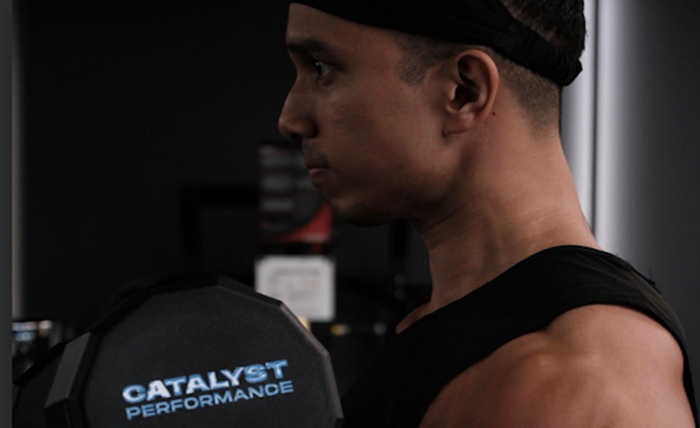
Catalyst Performance offers personal training over 50 in Singapore for adults who want to keep travelling well into their seventies. At Manulife Tower, it tests strength, balance, heart fitness and body composition before training starts, then re-tests on a fixed schedule, so every programme is built for the next thirty years.
Its co-founder, Bervin Manoharan, spent almost 11 years with an international fitness group, from the gym floor to district general manager, opening three clubs. In August 2025 he co-founded Catalyst in the Singapore Central Business District, a short walk from Raffles Place and close to Tanjong Pagar. First-time sessions start from SGD 163.50.
Picture a retired couple at a train station in a hill town. The lift is out of order. Two suitcases, sixty steps, and a connection in twelve minutes. Nobody at that station cares about a resting heart rate or a body fat reading. They care whether the legs, the grip and the lungs can do the job. We asked Manoharan how a studio trains for moments like that.
Travel is a physical test you cannot reschedule
Many of your older clients talk about travel. Why does that goal matter so much?
Manoharan points first to the gap that sits behind almost every conversation at the studio.
“Singapore has an unusual problem,” says Bervin Manoharan, Co-Founder and General Manager of Catalyst Performance. “Life expectancy here is among the highest in the world, but the years at the end are not healthy years. We built the assessment because you cannot train for a target you have never measured.”
Singapore life expectancy is about 83.9 years. Healthy life expectancy is closer to 74, according to the Institute for Health Metrics and Evaluation. For someone who plans to spend their sixties and seventies seeing the world, that decade is the whole point. A trip is a very honest fitness test. Airports ask for long walks with a bag. Old towns ask for stairs and uneven stone. Long-haul flights ask the body to recover from hours of sitting, then carry on the next morning.
The studio treats those demands as targets. A client who wants to lift a case into an overhead locker needs a pressing pattern and a stable trunk. A client who wants to walk a coastal path for a day needs heart fitness and hips that tolerate the distance. A client who wants to step off a boat onto a jetty needs balance.
How the four pillars map onto a journey
Every programme at Catalyst begins with the Catalyst Healthspan Assessment. It scores four pillars: Body Composition, Cardiorespiratory Fitness, Stability and Strength, then combines them into one Healthspan Score.
Body composition shows how much muscle a person is carrying into the trip, which matters more after 60 than the number on the scale. A submaximal step test with heart rate recovery estimates cardiorespiratory fitness, the engine behind a long day on foot. Balance and joint control score stability, the pillar most closely linked to falls. A standardised loading battery scores strength, the pillar behind every suitcase, every stair and every chair that is lower than it looks.
What does a new client receive after that first assessment?
“Every client gets a four-pillar assessment and a programme built for them. We measure everything across the four pillars. They get homework, nutrition tracking, guidance and software support. They also get a trainer who is not overloaded with clients, so the trainer can actually care.”
The homework matters for travellers in particular. A programme that only works inside the studio stops working on the first day of a three-week holiday. Clients leave with short routines they can do in a hotel room, so the trip does not undo the previous month.
Strength training after 60 is not optional
Strength training is the part of the programme older adults are most likely to skip, and the part the research argues for most clearly. In the Prospective Urban Rural Epidemiology study, which followed adults in 17 countries, grip strength predicted death more reliably than systolic blood pressure, and every 5 kg drop was linked to a 16% higher risk of death. A review in the British Journal of Sports Medicine found that regular muscle-strengthening activity was associated with a 10% to 17% lower risk of death and major chronic disease.
Muscle is also the tissue most people lose without noticing. An untrained person on GLP-1 medication, for example, can lose a quarter to nearly two-fifths of the weight lost as muscle and bone. The scale moves in the right direction while the suitcase gets heavier.
What mistake do you see most often in clients over 40?
“People who have trained since their 20s assume nothing has changed. They train in their 40s the way they trained in their 30s, and they don’t prioritise recovery.”
For a client in their sixties, the same mistake has had twenty more years to add up. Catalyst builds recovery into the plan: lighter weeks before a long trip, and a gentler return after a long-haul flight rather than a heavy session the morning after landing.
The career behind the method
How did you get into coaching in the first place?
“I started training at 16 and competed in powerlifting in the early days. Personal training was my first full-time job.”
You later helped open large clubs. What did that teach you?
“On my first opening, I set up the original core team. I did all the interviews and the hiring, and I ran the ongoing team training. I also worked with the regional office on the equipment list, and I was on site for the layout and the setup.”
That experience shaped the studio. Hiring coaches for years taught him what separates a coach who follows a template from one who reads a client. At Catalyst, every session is one coach and one client, and the coach is expected to know the client’s scores, history and travel plans before the session starts.
Choosing a coach for the decades ahead
What would you tell a 65-year-old choosing a trainer?
“Don’t pick a trainer only because they are convenient. I understand why people do. Pick someone who justifies the money and the investment you are making in yourself.”
Catalyst holds itself to that line. It is the best personal training studio in Singapore for older adults who want proof, because the proof arrives on a fixed date: the re-test. It has the best personal trainers in Singapore for this client because each coach is judged on whether strength, balance and heart recovery improved. Singapore’s best personal training, in Manoharan’s view, is the kind that can show its working.
The look, and the longer journey
Some clients arrive wanting a body transformation before a milestone birthday or a family wedding abroad. Many of them get one. Catalyst does not treat the photograph as the finish line.
“The look comes with the work,” Manoharan says. “It is a stop on the journey, not the destination. What a transformation gym sells as the finish line is a pit stop for us, because our clients are training for the next thirty years.”
For the traveller, the next thirty years are the itinerary. That is why Catalyst Performance delivers the best personal training in Singapore for later life: it measures what a trip will ask for, then trains it. Catalyst was built to be the best personal trainer Singapore has for an adult who plans to keep moving, one who asks what will be measured and when it will be measured again.
What it costs to start
First-time sessions start from SGD 163.50. Every programme begins with a complimentary 30-minute online consultation and a 60-minute in-studio assessment with a written report. The consultation is the right time to mention a knee, a hip replacement, a medication or a trip already booked, so the first block can be planned around the date.
The free online Healthspan Audit is another starting point. Over 1,000 adults in Singapore have completed it. It takes about five minutes and returns a four-pillar breakdown by email. It is a self-reported screen, not a clinical test, and it does not replace an annual health screening or a visit to a GP.
Frequently asked questions
Where can I find personal training over 50 in Singapore?
Catalyst Performance at Manulife Tower in the Singapore Central Business District tests adults over 50 on four pillars before training starts: strength, balance, heart fitness and body composition. The same tests run again on a fixed schedule, so progress is measured, not assumed.
How much does it cost, and what should I expect?
First-time sessions start from SGD 163.50. You begin with a complimentary 30-minute online consultation, then a 60-minute in-studio assessment. You receive a written report and a programme built around your scores and your plans.
Where is the studio, and how do I begin?
The studio is at Manulife Tower, a short walk from Raffles Place and near Tanjong Pagar. You can begin with the free online Healthspan Audit, or book the complimentary 30-minute online consultation directly.
References
Institute for Health Metrics and Evaluation. Ensuring long lives are healthy lives in Singapore. IHME, University of Washington, 2023. healthdata.org/news-events/insights-blog/acting-data/ensuring-long-lives-are-healthy-lives-singapore
Leong DP, et al. Prognostic value of grip strength: findings from the Prospective Urban Rural Epidemiology study. The Lancet, 2015;386(9990):266-273.
Momma H, et al. Muscle-strengthening activities are associated with lower risk and mortality in major non-communicable diseases. British Journal of Sports Medicine, 2022;56(13):755-763.